


The ‘Practical’ Magic of Marcy Bevan
Published September 25, 2025

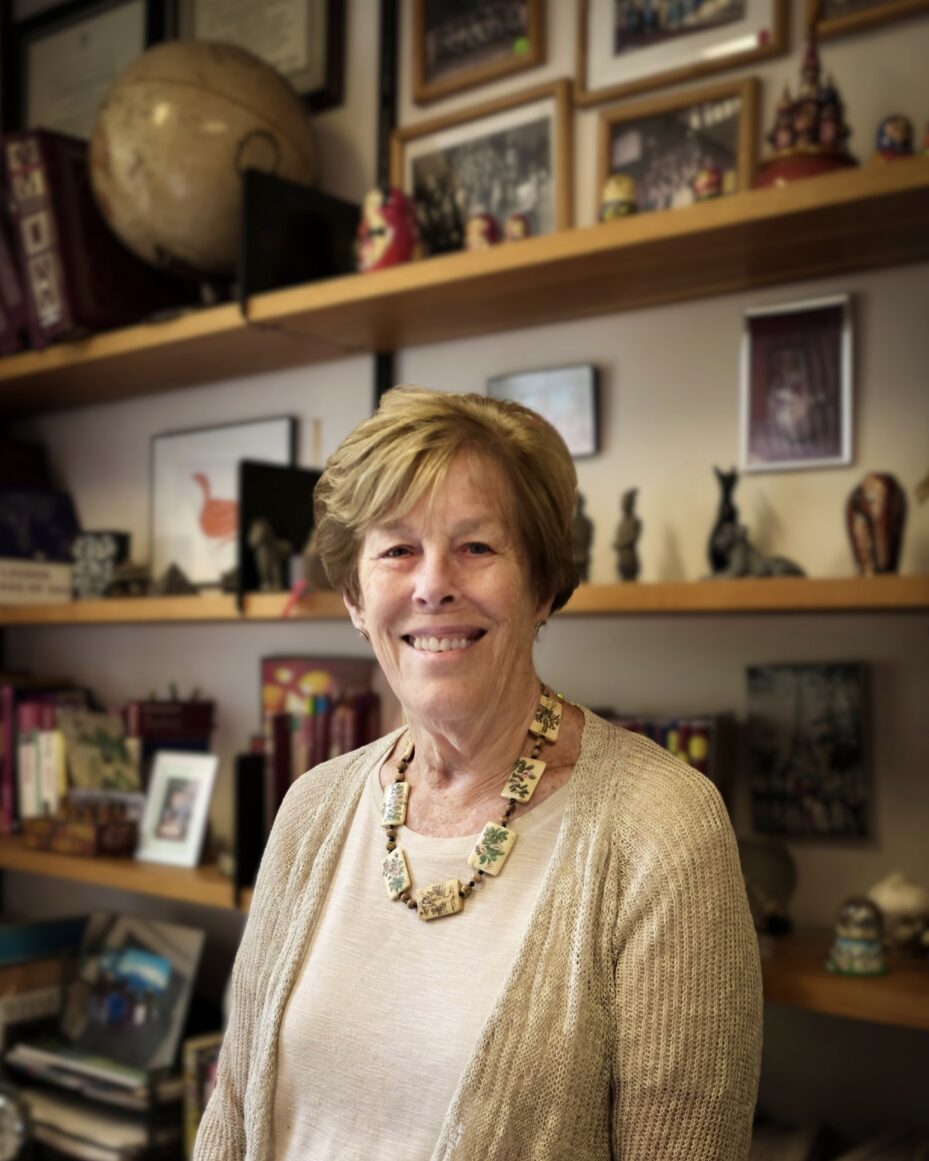
Anyone who has been through the doors of the Lauder Institute during its 40-year history has almost certainly met or heard of Marcy Bevan. As the long-time Director of Admissions and Alumni Relations, she is deeply woven into the story of the Institute and its graduates, her impact unmistakable. When Bevan first interviewed for the job in 1986, one administrator—now a close friend—doubted she was the right fit, dismissing her as “too cold” to connect with students. Nearly four decades later, Bevan, a beloved anchor in the Lauder community, has proven that assessment completely wrong. Her success stems as much from her administrative know-how as from her no-nonsense blend of wit and humility—qualities reflected even in her approach to this interview. When presented with questions in advance and asked if there were any she preferred not to answer, she replied dryly, “I don’t want to answer any of them.”
Bevan remembers the early days of her role vividly: admissions files arriving by mail, no alumni yet to manage, and her duties a mix of publications, events, and helping students secure international internships. A Philadelphia native and mother of three, she was an anomaly in a community of global travelers. “I’d only ever been out of the country once, and that was fine with me,” she admits. The class of ’87 gave her a globe for her office, a lighthearted gesture at the time but one that marked the start of a transformation. Today, Lauder’s influence on her international curiosity is undeniable: Bevan has visited more than 63 countries and counting.
She downplays her role in helping build Lauder’s exceptionally close-knit alumni network, instead crediting the program’s structure: “The students are the only ones on campus when they arrive. They travel together, live together, and share unique experiences. That closeness just builds naturally.” Still, alumni point back to Bevan’s knack for selecting the right people and modeling how to keep connections alive. Many drop in to “catch up” with Bevan, whose office is lined with 40 years’ worth of class photos. Her secret to relationship building? She argues there isn’t one: “Stay in touch. Remember details. Ask. Care. It’s not deliberate—I just enjoy it.”
When asked if there’s a common thread among Lauder’s most successful students, Bevan rejects the idea of a perfect formula, but notes one unfailing trait: curiosity—the instinct to dig beneath the surface. “It’s not just about going to see the Taj Mahal,” she explains. “It’s about asking why it was built, how it was funded, and what that says about the society. The students who succeed at Lauder tend to ask those kinds of questions.”
That same curiosity, paired with a clear-eyed pragmatism, has defined her own life. She traces it back, in part, to her mother. Bevan recalls one childhood memory when she begged for a robin as a pet. Her mother told her, “Put salt on its tail and it will become tame.” Young Marcy spent the day chasing the bird with a salt shaker, eventually realizing the impossibility of the task. “She’d give me the space to figure out problems on my own,” Bevan reflects. Those early lessons in practicality, she says, still shape the way she approaches her work today.
Over the years, she has witnessed Lauder transform in ways both subtle and sweeping. She recounts with ease board composition changes, programs that ended and started, and the reasons why. When asked whether the type of student Lauder attracts has changed, she offers a guarded response, pointing mainly to demographics. Early classes were dominated by U.S. students, with women making up only a small fraction. Today, the student body is more evenly split between domestic and international students, and she notes that it’s heartening to see how female enrollment in MBA programs has grown.
She has learned to read between the lines of admissions applications—many now polished by consultants or AI. “Without giving too much away, we have a lot of touch points with candidates,” she explains. “You learn who really understands and cares and who’s sort of phoning it in.”
For Bevan, the Institute’s mission has only become more urgent. “If you’re going to work internationally or with an international company—understanding other cultures, how business practices differ, and how people think in different places is essential,” she says. “It makes you more effective in your job, whether that’s knowing why a country builds a monument or simply recognizing that not everyone eats lunch at the same time.”
Her four decades at Lauder, which included earning her doctorate in higher education administration at Penn, have also meant adapting to dizzying technological change. She remembers communicating with students by Xerox, slipping printed memos into 50 individual mail folders; today, she admits, she can barely imagine life without her phone. Change hasn’t always come easily, but she takes it in stride. She reflects on a recent phone call with an AI bot, drolly observing that “they were very polite. It was a pleasant experience.”
In a world where multiple career transitions are now the norm, Bevan has charted an unusually steady course. Still energized by the students, alumni, and colleagues alike, she remarks, “I like the job. I like the people. Nice people, funny people, that’s what keeps me here.”
Asked what advice she offers prospective students, her answer doubles as a life philosophy: “Pay attention to your instincts. You’ll know if this is your place, your people. And if not, you’ll know that too.” ■
Story and Photography by Lauren Treutler